How AI Saves Property Managers 20+ Hours Every Week
How AI Saves Property Managers 20+ Hours Every Week
If you manage rental properties in Canada, your day probably looks something like this: you wake up to 30 unread emails, half of which are maintenance requests. You spend the morning returning calls, coordinating with contractors, chasing late rent payments, and answering the same tenant questions you answered yesterday. By 3 PM, you have not touched your actual priorities — leasing vacant units, building owner relationships, or growing your portfolio.
You are not alone. The average property manager spends over 60 percent of their working hours on repetitive administrative tasks. That is more than 25 hours per week on work that does not require human judgment, creativity, or relationship skills.
AI changes that equation completely. Organizations using AI in property management report a 20 to 30 percent improvement in operational efficiency. That translates to 10 to 20+ hours per week freed up — time you can reinvest in the parts of the job that actually grow your business.
Here is exactly where those hours are hiding and how AI gets them back.
Where Property Managers Lose the Most Time
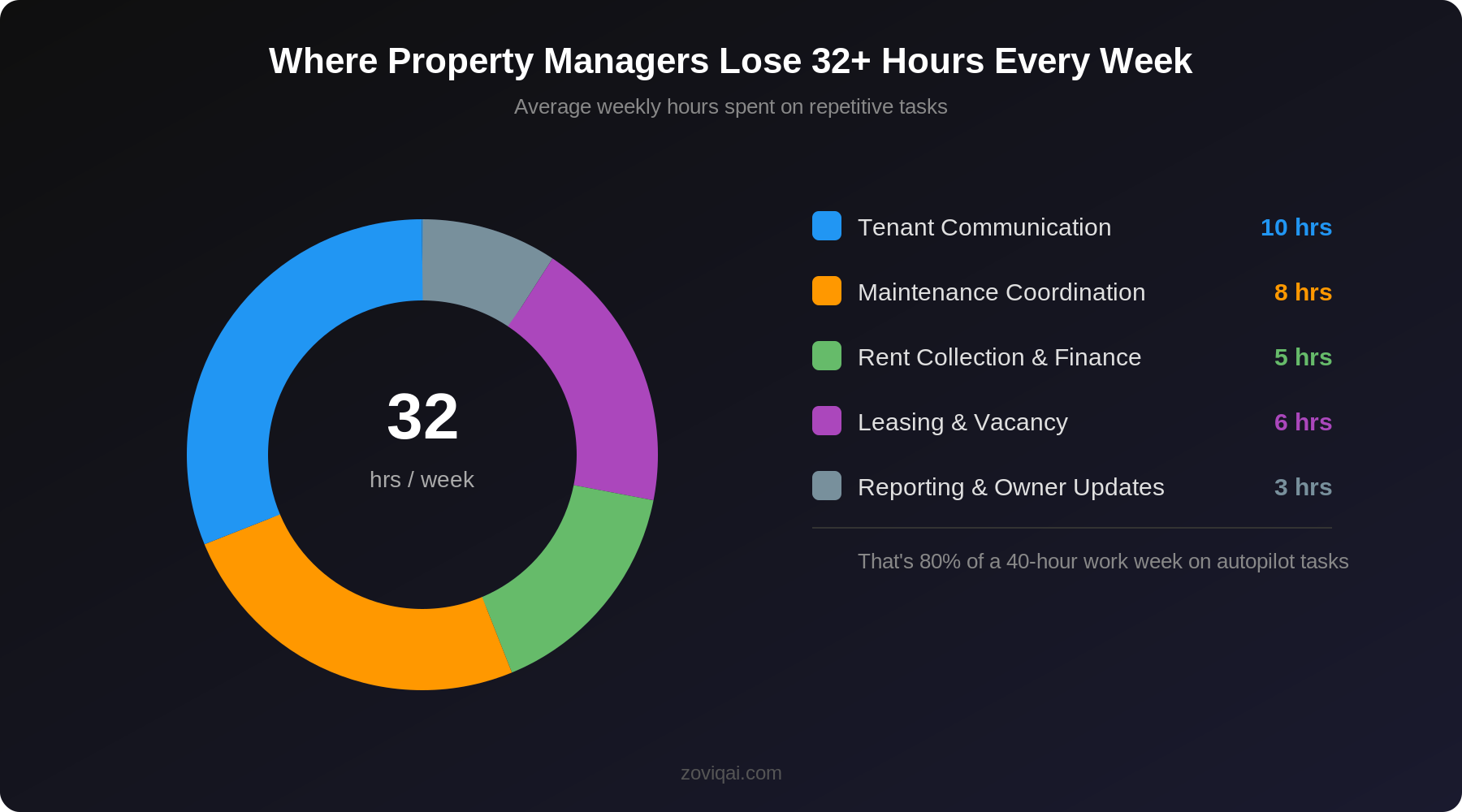
Before we talk about solutions, let us look at the problem. A typical property manager's week breaks down roughly like this:
Tenant communication: 8-12 hours per week. Answering calls, replying to emails, responding to portal messages, fielding the same questions about parking, laundry, lease terms, and move-in procedures — over and over. After-hours calls add another layer. Many managers either pay for expensive answering services at $200 to $500 per month or risk losing tenants to slow response times.
Maintenance coordination: 6-10 hours per week. Receiving requests, assessing urgency, calling contractors, getting quotes, scheduling work, following up on completion, and updating tenants on status. Most of this is done through a combination of email, phone calls, and spreadsheets.
Rent collection and financial admin: 4-6 hours per week. Sending payment reminders, tracking who has paid, processing late fees, reconciling accounts, and generating reports for property owners.
Leasing and tenant screening: 4-8 hours per week. Responding to listing inquiries, scheduling viewings, conducting background checks, processing applications, and preparing leases.
Inspections and documentation: 3-5 hours per week. Move-in and move-out inspections, documenting property conditions, filing reports, and updating records.
Add it all up and you are looking at 25 to 40+ hours per week on tasks that follow predictable patterns. That is the definition of work AI was built to handle.
The 5 Areas Where AI Makes the Biggest Impact
1. Tenant Communication — From 10 Hours to 1 Hour
This is the single biggest time drain, and it is the easiest to solve with AI.
An AI chatbot handles the bulk of tenant interactions automatically. It answers questions about lease terms, building policies, parking, amenities, and move-in procedures — 24 hours a day, 7 days a week. No voicemail. No waiting until Monday morning. No answering service.
When a tenant messages at 11 PM asking about the guest parking policy, the AI responds instantly with the correct answer pulled from your building's actual policies. When someone asks about lease renewal terms, the AI provides the details and offers to schedule a call with you if the tenant wants to discuss further.
For Canadian property managers, bilingual support is critical. An AI chatbot built for the Canadian market handles conversations in both English and French automatically, with language detection built in — essential for compliance with Quebec's Law 25.
Real impact: AI chatbots handle 70 to 80 percent of routine tenant inquiries without human involvement. That turns 10 hours of back-and-forth into about 1 hour of reviewing flagged conversations that actually need your attention.
2. Maintenance Request Triage — From 8 Hours to 2 Hours
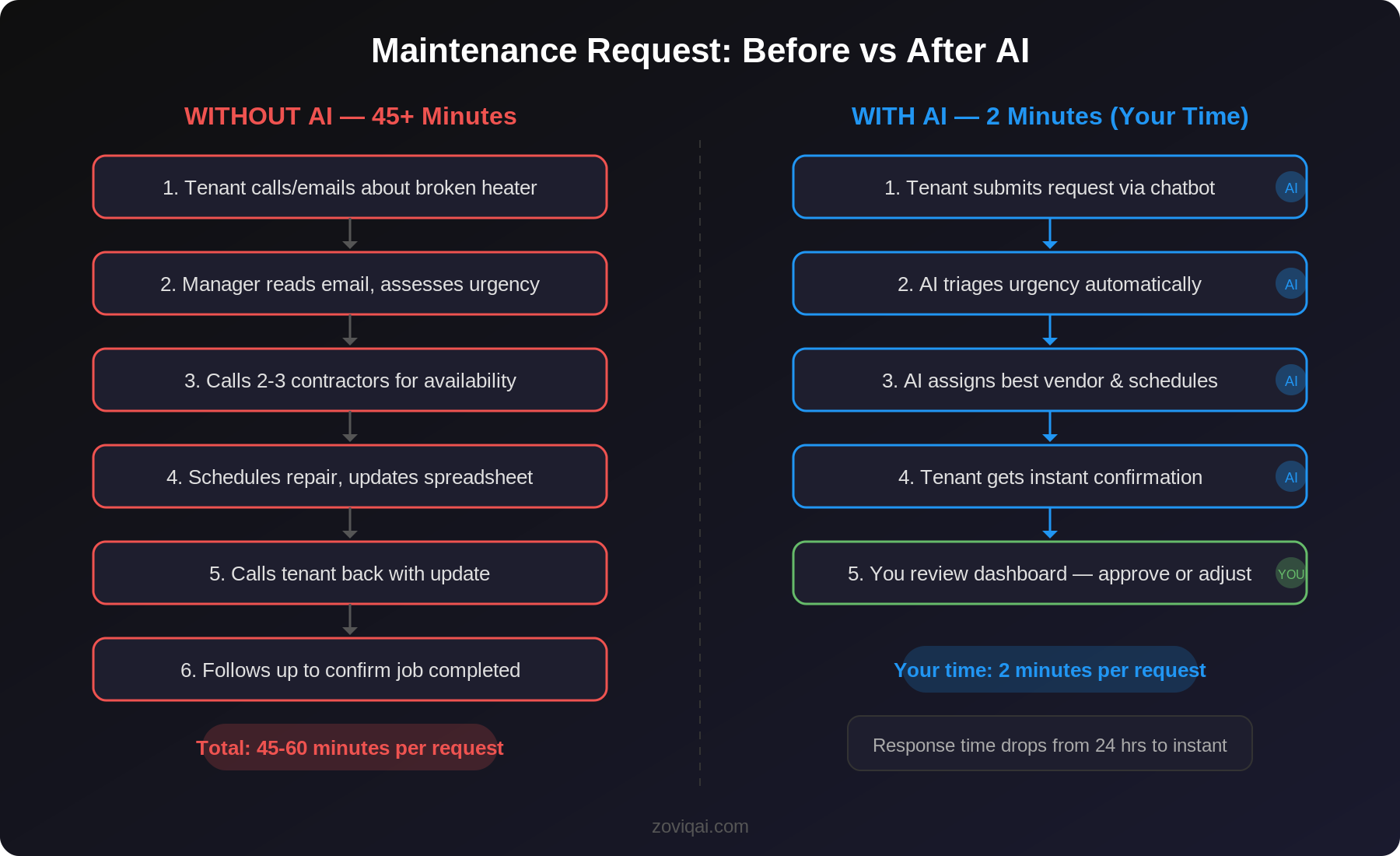
Maintenance is where property managers feel the most pain. The process is manual, fragmented, and time-sensitive. A burst pipe at 2 AM cannot wait until morning. A broken dishwasher can.
An AI agent transforms how maintenance works. Here is what happens when a tenant submits a request:
The AI reads the request and automatically categorizes it by urgency — emergency, urgent, or routine. It creates a work order with all the relevant details. It checks your vendor list and assigns the right contractor based on availability, location, and specialization. It sends the tenant a confirmation with an estimated timeline. It follows up with the vendor to confirm the job is scheduled. Once complete, it closes the ticket and notifies the tenant.
All of this happens without you picking up the phone.
Industry data shows that AI-powered vendor management cuts response times by 45 percent, and workflow automation reduces errors by 62 percent. AI-powered inspections complete 3 times faster than manual processes.
Real impact: Instead of spending 8 hours coordinating maintenance, you spend 2 hours handling the edge cases — the complex situations that genuinely need a human decision.
3. Rent Collection and Payment Follow-up — From 5 Hours to 30 Minutes
Chasing late payments is tedious and awkward. Nobody enjoys calling a tenant to ask about overdue rent. AI removes the awkwardness and the time drain entirely.
An AI system sends automated payment reminders before rent is due. On the due date, it confirms receipt for tenants who have paid and sends a polite reminder to those who have not. At day 3, it escalates with a more direct notice. At day 7, it generates a formal late payment notice.
For tenants who respond to reminders with questions or requests for payment plans, the AI handles the initial conversation — collecting the relevant information and presenting options based on your policies. It only escalates to you when a decision outside standard policy is needed.
The AI also reconciles payments against your records automatically, flags discrepancies, and generates financial reports for property owners without you manually pulling numbers from spreadsheets.
Real impact: From 5 hours of chasing payments and building reports down to 30 minutes reviewing exceptions and approving payment arrangements.
4. Leasing and Vacancy Management — From 6 Hours to 1.5 Hours
Every day a unit sits vacant costs you money. The problem is that prospective tenants often inquire outside business hours and expect quick responses. If you reply the next morning, they have already contacted three other landlords.
An AI leasing assistant responds to every inquiry instantly — at 8 PM, at midnight, on weekends. It answers questions about the unit, provides virtual tour links, and books viewing appointments directly into your calendar. No back-and-forth emails trying to find a time that works.
For application processing, an AI agent collects applicant information, runs initial screening against your criteria, flags potential issues, and presents you with a summary so you can make a decision in minutes instead of spending an hour per application.
Real impact: Faster response times mean fewer lost leads. Automated screening means less time per application. Six hours of leasing work becomes 90 minutes of reviewing shortlisted applicants and showing up for viewings.
5. Reporting and Owner Communication — From 3 Hours to 15 Minutes
Property owners want regular updates — financial reports, occupancy rates, maintenance summaries, market comparisons. Building these reports manually from multiple data sources is time-consuming and error-prone.
An AI agent pulls data from your property management system, accounting software, and maintenance logs. It generates professional reports automatically — monthly financials, maintenance summaries, occupancy trends — and sends them to owners on a schedule you set.
When an owner asks a question like "what was our maintenance spend last quarter compared to the year before?" the AI retrieves the answer in seconds instead of you spending 30 minutes digging through spreadsheets.
Real impact: Three hours of report building per week becomes 15 minutes of review before the AI sends them out.
The Numbers Add Up
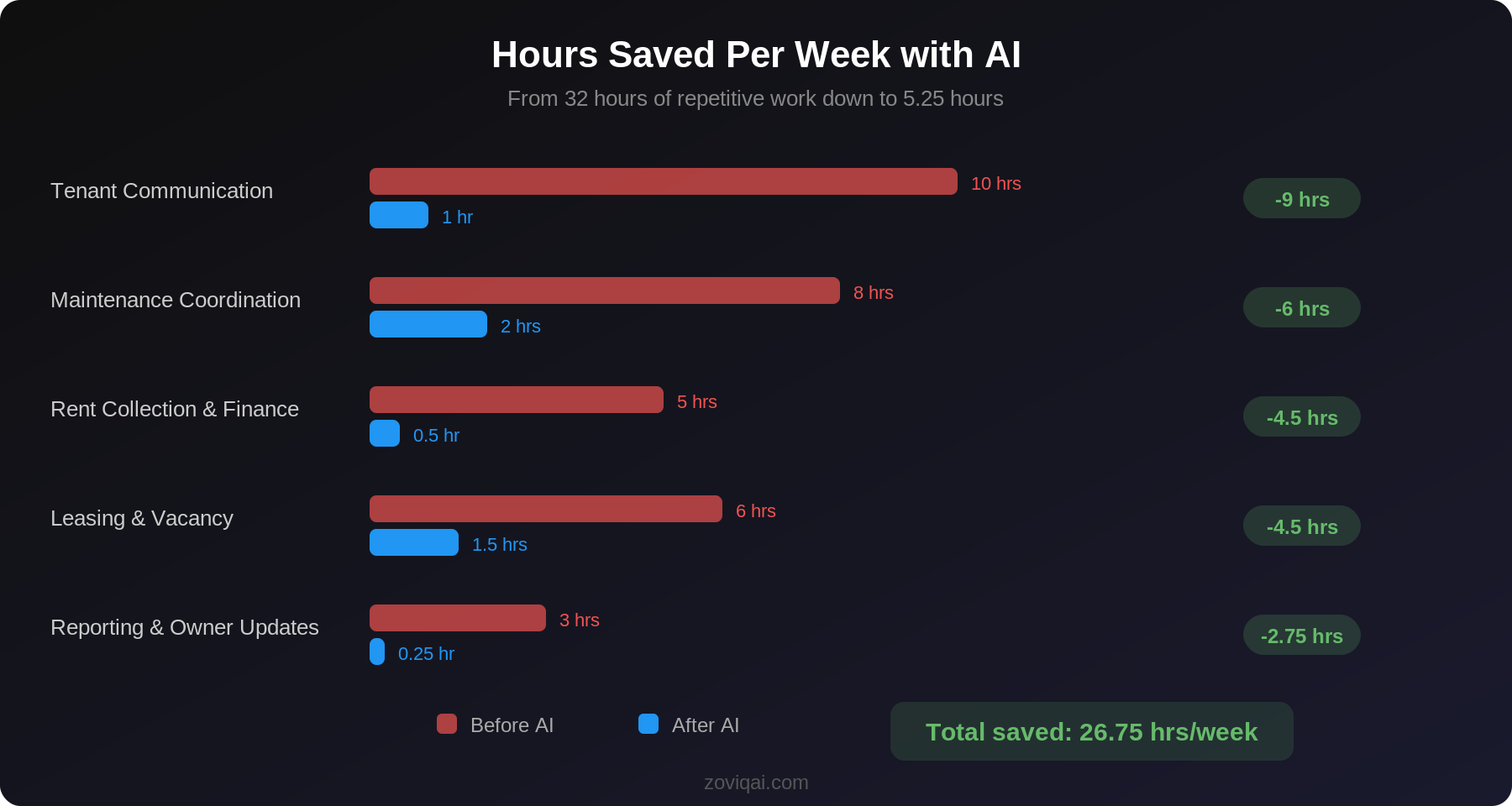
Here is what the total time savings look like across all five areas:
| Task | Before AI (hrs/week) | After AI (hrs/week) | Hours Saved |
|---|---|---|---|
| Tenant communication | 10 | 1 | 9 |
| Maintenance coordination | 8 | 2 | 6 |
| Rent collection & finance | 5 | 0.5 | 4.5 |
| Leasing & vacancy | 6 | 1.5 | 4.5 |
| Reporting | 3 | 0.25 | 2.75 |
| Total | 32 | 5.25 | 26.75 |
That is nearly 27 hours per week — more than half a full-time job. For a solo property manager handling 50 to 100 units, that is the difference between working 60-hour weeks and working 35-hour weeks. For a property management company, that is the equivalent of hiring additional staff without the salary cost.
The industry data backs this up. AI adoption among property managers jumped from 21 percent in 2024 to 34 percent in 2025, and the numbers continue to climb in 2026. The early adopters are pulling ahead — managing more units with fewer people and delivering better tenant experiences.
What This Looks Like in Practice
Let us walk through a real scenario.
It is Tuesday morning. You manage 80 units across four buildings in Montreal. Before AI, your day starts at 7 AM checking messages:
- 14 tenant emails (parking question, noise complaint, 3 maintenance requests, lease renewal inquiry, 6 payment questions, 2 move-out notices)
- 3 missed calls from last night
- 2 owner emails asking for updates
That is your entire morning gone before you have done anything proactive.
With AI in place, here is what your Tuesday looks like. You arrive at 9 AM and check your dashboard:
- The AI chatbot handled 11 of 14 tenant emails overnight — parking question answered, payment questions resolved, lease renewal info sent
- 3 maintenance requests were auto-triaged: 1 emergency (burst pipe — contractor already dispatched at 2 AM), 1 urgent (no hot water — plumber scheduled for 10 AM), 1 routine (squeaky door — handyman booked for Thursday)
- Owner reports were auto-generated and sent last night
- 2 items flagged for your attention: a noise complaint that needs investigation and a move-out with a damage dispute
You spend 45 minutes on the two flagged items. By 10 AM, you are free to focus on leasing your vacant unit, meeting a potential property owner client, or simply having a manageable workday.
Getting Started Without a Massive Budget
You do not need to automate everything at once. Most property managers see the biggest ROI by starting with these two:
Step 1: AI chatbot for tenant communication. This solves your highest-volume time drain immediately. A bilingual chatbot trained on your building policies, FAQ, and lease terms can be live within two to three weeks. It handles inquiries 24/7 and escalates to you only when needed.
Step 2: AI maintenance triage and vendor coordination. This is your second-biggest time drain and your biggest source of stress. An AI agent that categorizes requests, creates work orders, and dispatches vendors removes the most painful part of your day.
These two alone typically save 15+ hours per week. From there, you can expand to automated rent collection, leasing assistance, and owner reporting as you see the results.
Compliance Matters for Canadian Property Managers
Any AI system handling tenant data in Canada must comply with PIPEDA at the federal level and provincial regulations like Quebec's Law 25. This is non-negotiable.
When evaluating AI solutions, ensure the provider offers data residency in Canada, proper consent management, encryption, access controls, and audit logging. Bilingual support is not optional if you operate in Quebec — it is a legal requirement.
Every solution Zoviq AI builds is designed for Canadian compliance from day one. Your tenant data stays in Canada, privacy-by-design principles are built into the architecture, and bilingual operation in English and French is standard.
The Bottom Line
Property management is one of the most time-intensive industries in Canada. The managers who adopt AI are not replacing their teams — they are freeing their teams to do higher-value work. They are responding to tenants faster, filling vacancies sooner, keeping owners happier, and growing their portfolios without burning out.
The technology exists today. It is proven. And it is more affordable than most property managers expect.
Want to see how much time AI could save your specific operation? Book a free 30-minute consultation with the Zoviq AI team. We will map your current workflows, identify the biggest time drains, and show you exactly what automation looks like for your portfolio. No commitment. No pressure. Just clarity.
Zoviq AI Technologies Inc. is a Canadian AI agency based in Laval, Quebec. We build custom AI chatbots, AI agents, and automation systems for property management companies across Canada. PIPEDA and Law 25 compliant. Bilingual service in English and French.
Ready to explore AI for your business?
Book a free consultation. No commitment, no jargon — just an honest conversation about what AI can do for your business.
Related posts
- 7 min read
AI Agents vs Chatbots: What Canadian Businesses Need to Know in 2026
AI agents and chatbots are not the same thing. One answers questions. The other takes action. Here is what Canadian business owners need to understand before investing in either.
Read more - 2 min read
How Canadian Businesses Can Adopt AI Without Compromising Privacy
AI adoption and PIPEDA compliance are not mutually exclusive. Here's how Canadian businesses can deploy AI agents and chatbots while keeping customer data safe and meeting Quebec's Law 25 requirements.
Read more